When we talk about telephones, we all know the famous SIM card : the small chip that needs to be inserted for your phone to work. But in recent years, a new development has appeared: the’eSIM.
So, is it just a fad or a real revolution? Let's end the suspense and look at the fundamental differences together.
SIM vs eSIM: Same role, but two ways of doing it
Whether it's a classic SIM or an eSIM, their mission is the same: identify your phone with your mobile operator. It is thanks to this identification that you can make calls, send messages and browse the Internet.
The major difference lies not in the function, but in the shape.
1. The standard SIM card
The SIM (for Subscriber Identity Module) is the physical card you have always used.
-
- It's what ? A small plastic card with a chip, which you need to cut to the correct size (Mini, Micro, Nano) and insert into your phone.
-
- Activation: It is already programmed by the operator and is usually activated upon insertion.
-
- Change : To change operators or phones, you must remove the card and insert another one (or put it back in).
In other words: It is an object that can be touched and exchanged.
2. The eSIM
The eSIM (for Embedded SIM, (i.e., integrated SIM) is the dematerialized and modern version.
-
- It's what ? A tiny little flea integrated directly It's in the motherboard of your smartphone, tablet, or smartwatch. It's there, and you can't remove it. It allows you to configure your phone for the carrier of your choice.
-
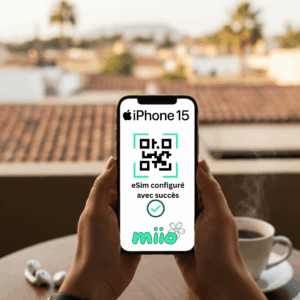
- Activation: It is activated remotely by the operator, often by scanning a QR code or via an application.
-
- Change : To switch operators, there's no need to send anything else by post! You simply download a new "profile" via a link or a QR code.
In other words: It's no longer a card, but simply a piece of software that you install.
The advantages of eSIM: Why is everyone talking about it?
The switch to digital is not just a technical detail. It brings very tangible benefits, especially for those who travel a lot:
| Advantage | Physical SIM (Nano-SIM) | eSIM (Integrated) |
| Flexibility | Physical card change. | Switching operators a few clicks. |
| Travel | Purchase of a local SIM card and replacement. | Setting up a local package instant (No more searching for a shop!). |
| Security | It can be stolen or damaged. | Therefore, it is impossible to remove physically. more secure against theft. |
| Double Line | Requires a "dual SIM" phone. | Allows you to have two or more numbers on a single device (Professional + Personal) very easily. |
| Ecology | Generates plastic and packaging. | Zero waste plastic and no transport. |
Is my phone compatible?
That's the million-dollar question! eSIM is a recent technology. It's available on:
-
- THE latest models of iPhone (since the iPhone XS, and even the eSIM alone in the USA).
-
- Most smartphones high-end recent releases from Samsung, Google Pixel and others.
-
- Some smartwatches and tablets.
If you have a phone that is more than 3 or 4 years old, it is likely that it only supports the classic SIM card.
For more information, see the List of compatible phones.
In summary: Is eSIM the future of connectivity?
The physical SIM card does its job well and remains universal. However, the’eSIM is clearly the future. It offers simplicity, flexibility (especially when traveling) and a better security.
If you have a compatible phone, switching to eSIM is a small step towards greater everyday convenience. It means less plastic to deal with and more freedom for your mobile line.
Did you know that? Some recent smartphones allow the use of both a physical SIM AND an eSIM! The best of both worlds for having two numbers.
Ready to take the plunge?
Do you want to know if your phone can use an eSIM today?
 Click ici Check your device's compatibility in 30 seconds!
 What do you think of this transition? Have you already switched to eSIM?